Using the command bar
Learn how to use the Command Bar in ShiftControl to search and quickly access key features such as users, groups, and apps.
Overview
Clicking through menus is slow. The Command Bar gives you keyboard-driven access to everything in ShiftControl -- search for users, jump to a page, or start a workflow -- all without lifting your hands from the keyboard. If you have used Spotlight on macOS or the command palette in VS Code, the concept is the same.
How It Works
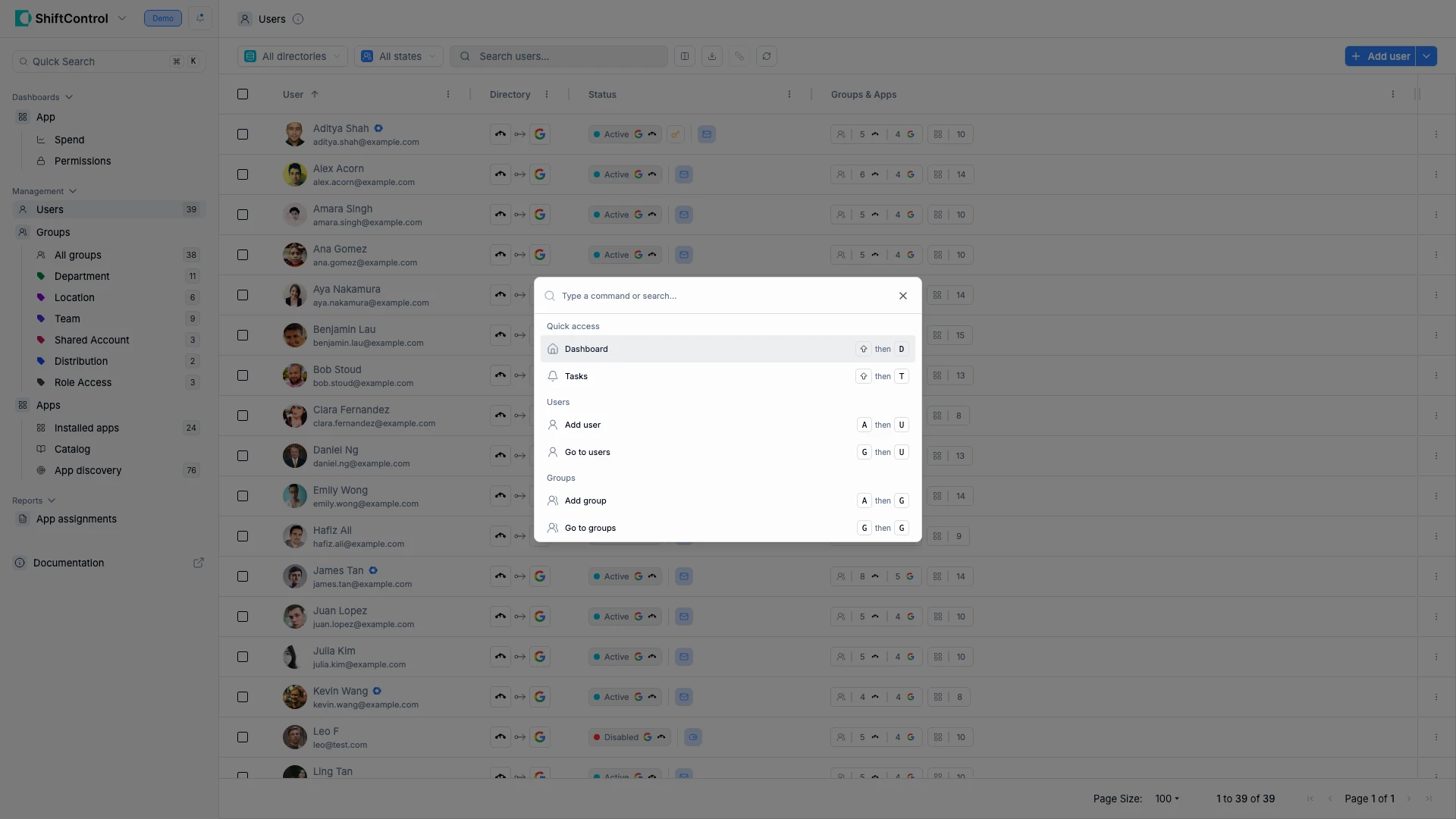
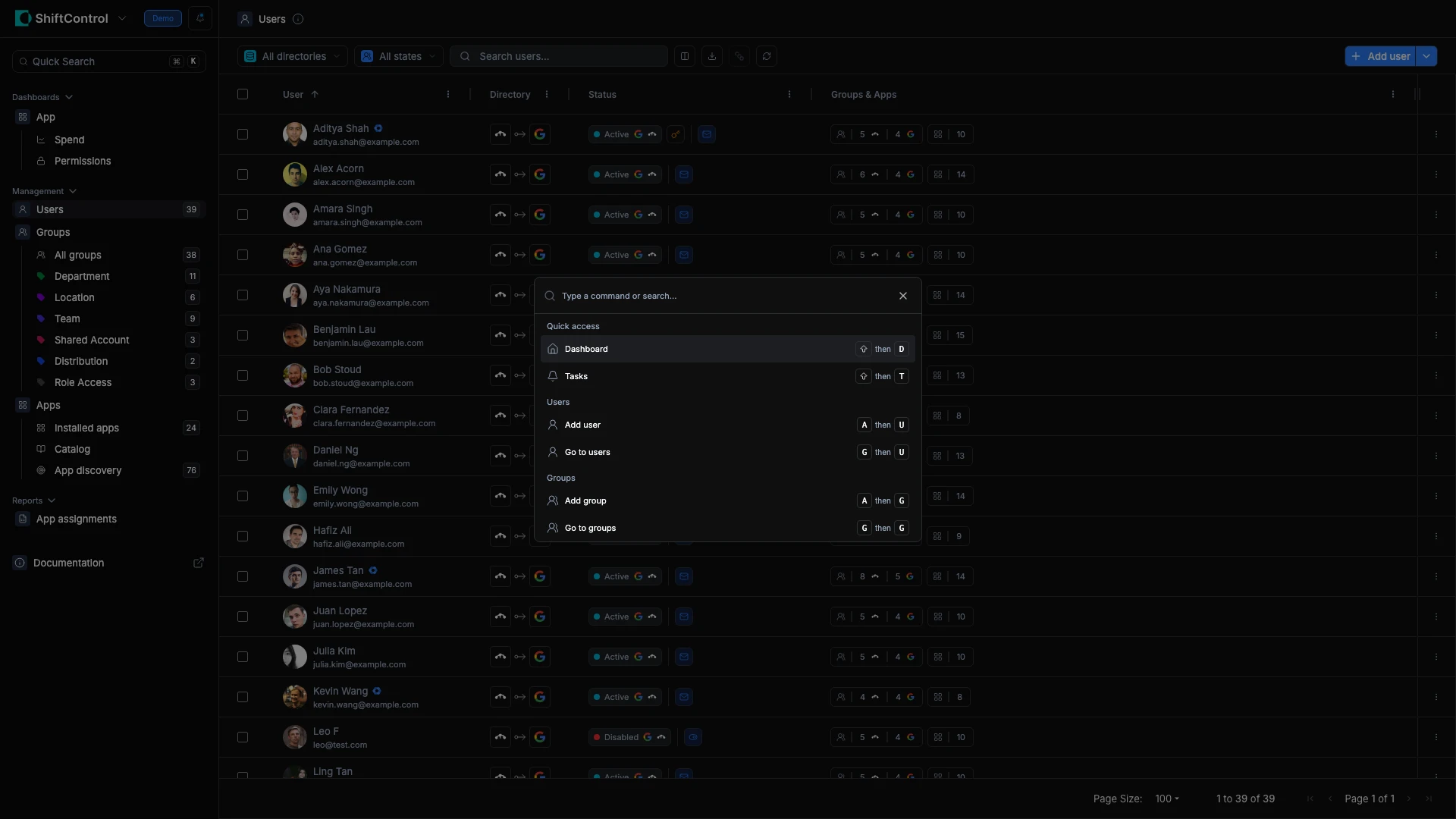
The Command Bar is a search-and-action overlay available on every page in ShiftControl. It works in two modes:
- Search mode -- Open the Command Bar and start typing to search across users, groups, and apps. Results appear in real time and you can select one to navigate directly to it.
- Shortcut mode -- Press a key sequence (like
AthenU) from anywhere in ShiftControl to jump straight to an action such as adding a user. You do not need to open the Command Bar first -- shortcuts work directly from any page.
Common Scenarios
| Scenario | What to do |
|---|---|
| Find a user quickly | Open the Command Bar, type part of their name or email, select from results. |
| Add a new user | Press A then U from any page. You are taken directly to the Add User form. |
| Jump to the dashboard | Press Cmd then D from anywhere. |
| Check your tasks | Press Cmd then T to go straight to the task list. |
| Navigate to a specific app | Open the Command Bar, type the app name, select it from the results. |
Opening the Command Bar
Use any of these methods:
- Press Cmd + K on macOS (or Ctrl + K on Windows).
- Click the Quick Search bar at the top of any page.
The Command Bar opens as an overlay. Press Esc or click outside to close it.
Searching
With the Command Bar open, start typing. ShiftControl searches across:
- Users -- by name or email.
- Groups -- by group name.
- Apps -- by app name.
Results update as you type. Select a result to navigate directly to that item's detail page.
Keyboard Shortcuts
ShiftControl supports key sequences for common actions. These shortcuts work from any page -- you do not need to open the Command Bar first.
Quick Access
| Shortcut | Action |
|---|---|
Cmd then D | Go to Dashboard |
Cmd then T | Go to Tasks |
Add Something
| Shortcut | Action |
|---|---|
A then U | Add User |
A then G | Add Group |
A then A | Add App |
Go to a Section
| Shortcut | Action |
|---|---|
G then U | Go to Users |
G then G | Go to Groups |
G then A | Go to Apps |
G then D | Go to App Discovery |
G then I | Go to Integrations |
The pattern is consistent: A means "add," G means "go to," and the second key identifies the target.
Things to Know
- The Command Bar is available on every page. You do not need to navigate to a specific section first.
- Keyboard shortcuts are key sequences, not simultaneous key presses. Press the first key, release it, then press the second.
- Search is not case-sensitive. Partial matches work.
- The Command Bar closes automatically after you select a result or execute a shortcut.
Related Features
- Task Management -- Quickly accessible via
CmdthenTfrom the Command Bar. - User Management -- Add or find users directly from the Command Bar.
- Group Management -- Add or navigate to groups without leaving the keyboard.