User Management
Your single view of every person in your organization — who they are, what they can access, and whether their security is in order.
Overview
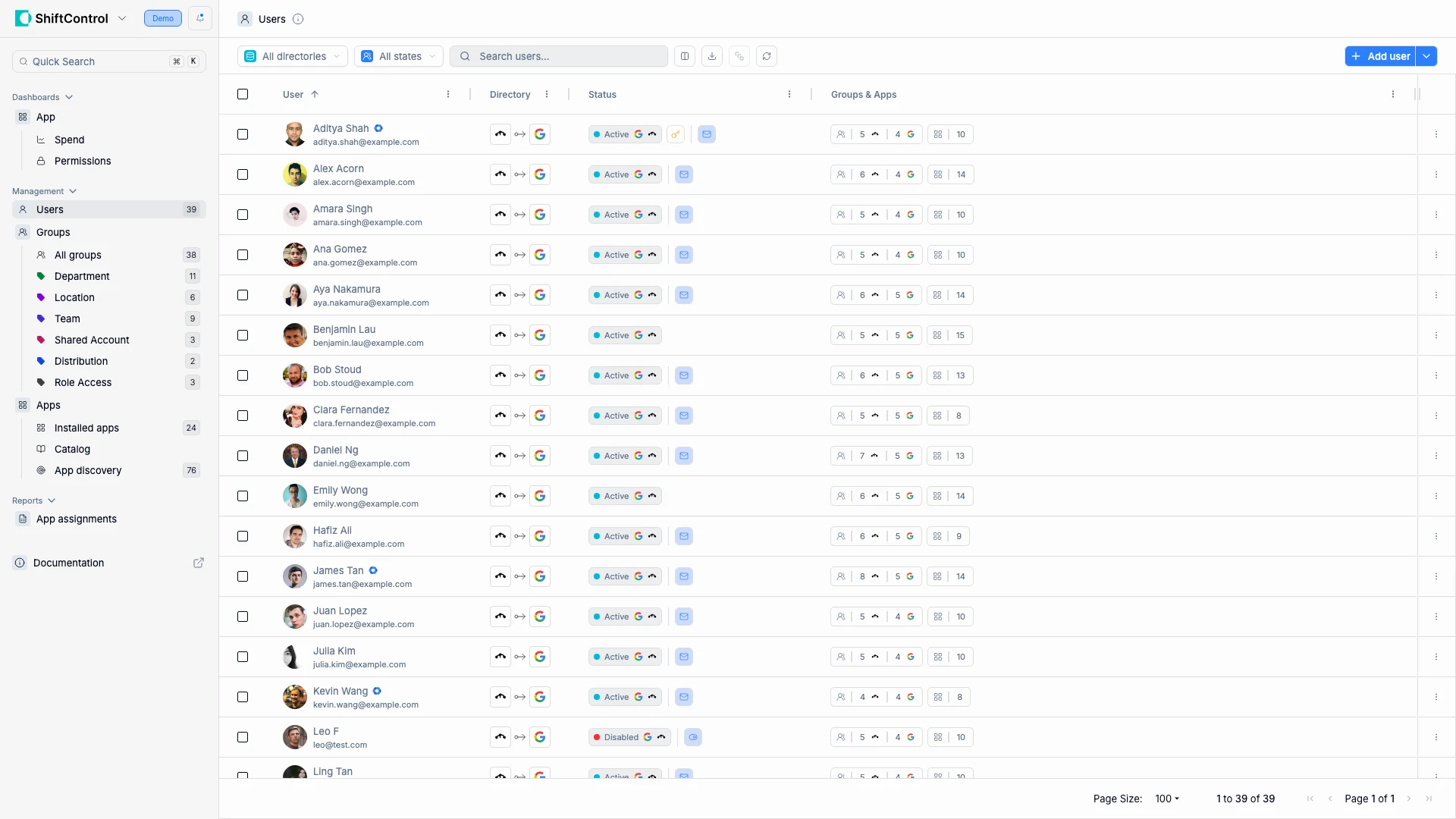
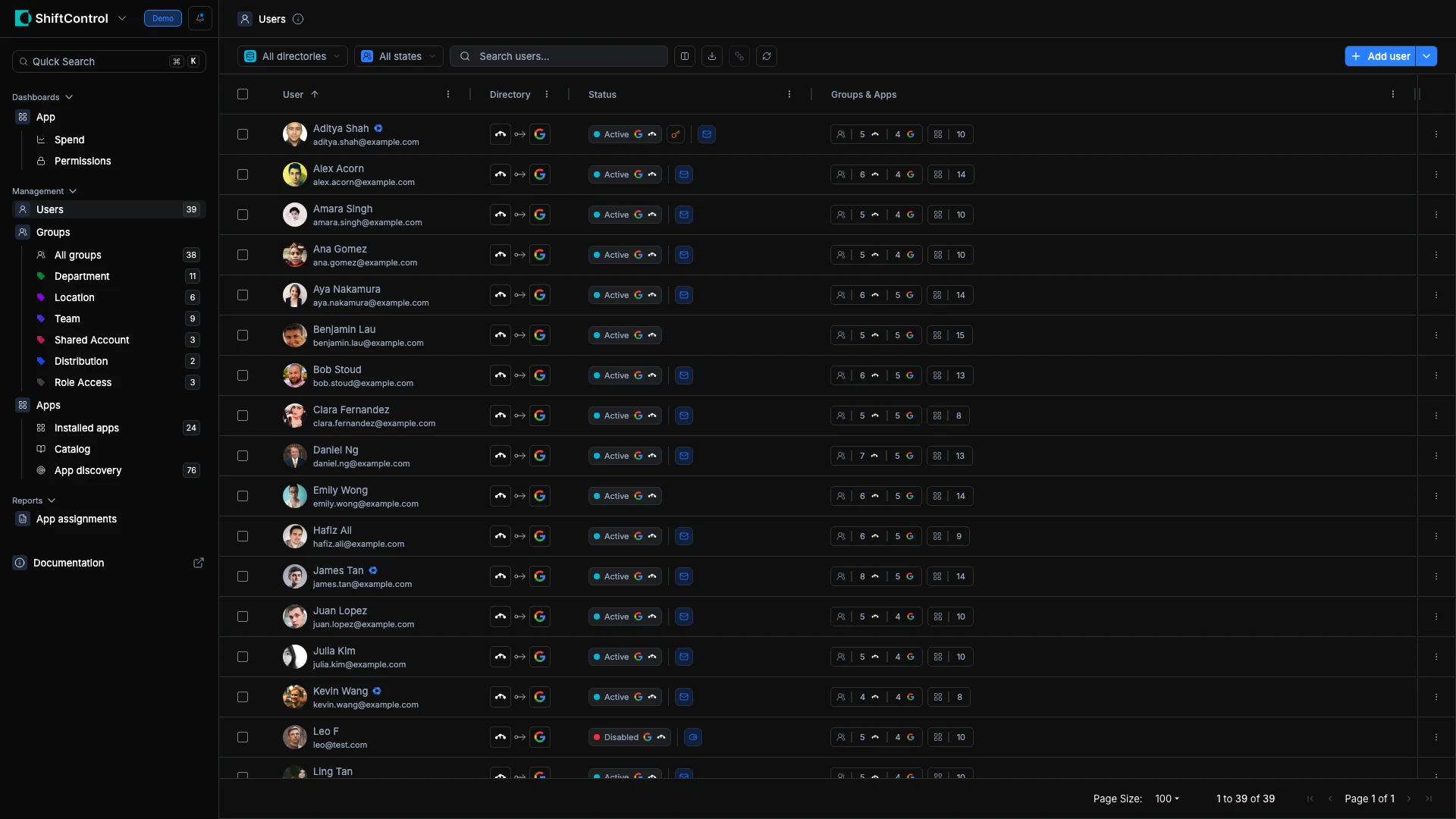
The Users page is the heart of ShiftControl. Every person in your organization has a row here, and that row tells you everything you need to know at a glance: their identity, which directories they belong to, whether they're active, and how many groups and apps they touch.
When you make changes here, they ripple through your entire stack. Activate a user and they get access to every app their groups provide. Deactivate them and access is revoked everywhere. Change their department and their group memberships — and therefore their app access — update automatically.
With both JumpCloud and Google Workspace connected, the Users list shows identity data from both directories in a unified view. Each user row displays directory icons for JumpCloud and Google Workspace side by side — so you can immediately see which directories a user exists in and whether they're synced to both.
What You See
Each row in the users table shows:
| Column | What It Tells You |
|---|---|
| User | Name, email, and avatar — this is the identity used across all connected systems |
| Directory | Icons showing which directories the user exists in |
| Status | Active (can authenticate) or Inactive (access suspended) |
| Groups & Apps | How many groups they belong to and how many apps they can access |
Use the filters to narrow down what you're looking at:
- Directory filter — Show users from a specific directory only
- Status filter — Active, Inactive, or all
- Search — Find users by name, email, or other attributes
Common Scenarios
Auditing access before a compliance review
Your security team needs a list of everyone with active access. Filter to Active users, then review the Groups and Apps counts. Users with unusually high app counts warrant a closer look — click into them to see their full permissions. You can export this data for your compliance documentation.
Finding inactive users who still have app access
Filter by Inactive status. If any inactive user still shows a non-zero Apps count, their deprovisioning didn't complete fully. Click in to investigate and revoke remaining access. This is a common finding during security audits.
Bulk onboarding a new team
Your company acquired a five-person design team. Add each user and assign them to the Design group — their app access (Figma, Slack, Google Workspace) provisions automatically based on group membership. No need to configure apps one at a time.
User Actions
Click the ⋮ menu on any user row for quick actions.
When both directories are connected, the context menu shows a directory selector first — choose JumpCloud or Google Workspace, then see the actions available for that directory. This lets you manage each directory identity independently.
JumpCloud actions (shown for users in JumpCloud):
- Edit — Open the user's JumpCloud profile for editing
- Send activation instructions — Send setup email with login credentials and MFA instructions
- Set password — Manually assign a password
- Schedule deactivation — Set a future date to revoke access
- Disable — Immediately suspend the user's JumpCloud account
- Delete — Permanently remove the user from JumpCloud
Google Workspace actions (shown for users in Google, varies by user status):
- Suspend / Restore — Suspend or restore a Google Workspace account (active users can be suspended; suspended/archived users can be restored)
- Reset password / Send password reset — Reset or email a password reset link
- Send sign-in instructions — Send login instructions (shown for users who haven't logged in yet)
- Sign out all sessions — Force sign-out from all Google sessions
- Change organizational unit — Move the user to a different Google OU
- Archive — Archive the Google Workspace account (preserves data, revokes access)
- Delete — Permanently delete the Google Workspace account
- Edit — Open the user's profile for editing
- Send activation instructions — Send the setup email with login credentials and MFA instructions
- Set password — Manually assign a password
- Schedule deactivation — Set a future date to revoke access
- Disable — Immediately suspend the user's account
- Delete — Permanently remove the user
Actions vary by the user's current status (active, suspended, or archived):
- Suspend / Restore — Suspend or restore the Google account
- Reset password / Send password reset — Reset or email a password reset link
- Send sign-in instructions — Send login instructions for new users
- Sign out all sessions — Force sign-out from all Google sessions
- Change organizational unit — Move to a different Google OU
- Archive — Archive the account (preserves data, revokes access)
- Delete — Permanently delete the account
Actions are context-sensitive — only actions that apply to the user's current status and your permissions are shown. For example, you won't see "Suspend" on an already-suspended user, or "Delete" if you don't have delete permissions.
Bulk Actions
Select multiple users with the checkboxes, then choose an action from the bulk menu. This is how you handle operations at scale — seasonal onboarding, department-wide password resets, or end-of-contract offboarding.
The bulk menu shows a directory sub-menu — select JumpCloud or Google Workspace to apply the action to that directory for all selected users.
JumpCloud bulk actions: Activate, Send activation instructions, Cancel scheduled activation, Schedule deactivation, Cancel scheduled deactivation, Disable, Enable, Send password reset, Force password reset, Set password, Delete
Google Workspace bulk actions: Suspend, Restore, Delete
Activate, Send activation instructions, Cancel scheduled activation, Schedule deactivation, Cancel scheduled deactivation, Disable, Enable, Send password reset, Force password reset, Set password, Delete
Suspend, Restore, Delete
Each action is only enabled when at least one selected user is eligible. For example, "Activate" is disabled if all selected users are already active.
Things to Know
- Changes take effect immediately. Activating, deactivating, or disabling a user pushes the change to your connected directories in real time. From there, it cascades to every connected application.
- Dual-directory visibility. The Directory column shows icons for each directory a user belongs to. If someone is missing from one directory, you'll see only one icon — a quick way to spot sync issues.
- Deactivation vs. disabling. Deactivating suspends access but preserves the account and its data. Disabling is more aggressive — use it when someone needs to be locked out immediately and you don't need to preserve their state.
- Scheduled actions aren't instant. A scheduled deactivation means the user keeps full access until that date. Double-check the date if timing is critical for security.
- Pagination. The list shows 10 users per page. The total count (e.g., "1 to 10 of 36 users") is always visible at the bottom.
Related Features
- Adding a User — Create a new identity and start the onboarding process
- Editing a User — Update details, review security, audit permissions, track costs
- Groups — Manage the groups that control what apps users can access